Peace Finance Platform Session: From Peace-Relevant Practices to Financial Decisions
Five cases, emerging opportunities and the next steps for the Peace Finance Platform
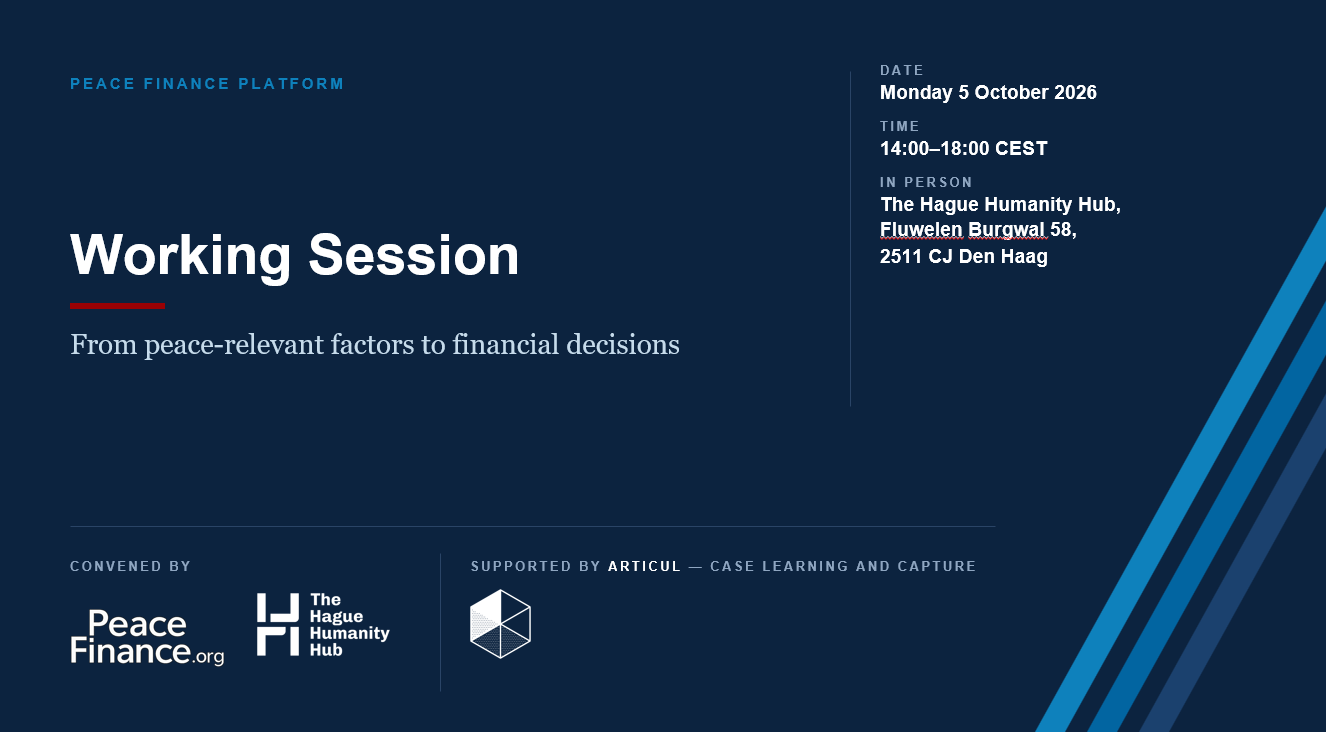
On 5 October 2026, the Peace Finance Platform brought together organisations working across peacebuilding, business and finance to explore how peace-relevant practices and relationships could influence business performance, investment outcomes and financing decisions.
Date: 5 October 2026
Initiative: Peace Finance Platform
Summary of this session
The session brought together five cases presented by PeaceEye, Brokers for Peace, the African Development Bank together with Investing and Partnering with Youth for Peace and Cordaid, PeaceNexus Foundation together with Investisseurs & Partenaires, and the Investing for Peace Initiative.
The cases covered different approaches, including conflict-related information services, local economic resilience, youth enterprise development, inclusive business practices and investment through financial intermediaries. Together, they provided a practical basis for exploring how peace-related considerations can influence financing decisions and investment design.
A central question was how financing could intentionally enable or strengthen ordinary business practices – such as sourcing, hiring, participation, cooperation and access arrangements – that contribute to conditions for peace while also helping enterprises perform better, manage risks or build resilience.
The discussions highlighted the importance of identifying specific, observable mechanisms: what changes in the way a business operates, what difference this could make to its performance or resilience, and whether that difference could influence an actual investment or financing decision.
The five cases also opened up several promising directions for further exploration.
Emerging opportunities
From cooperation to commercial resilience
Business relationships, local coordination and cooperation across communities may support economic continuity in fragile settings. The opportunity is to explore when these capabilities improve the resilience and performance of individual enterprises, and how this could influence investment assessment, support and financing.
From inclusion to investment decisions
Meaningful participation, inclusive hiring and sourcing, and fairer access to economic opportunities may influence both business performance and underlying conditions for peace. These possibilities could be explored through existing enterprise assessment, technical assistance and financing programmes.
From peace intentionality to business practice
Peace intentionality needs to enter investment decisions early enough to influence what is financed, how investments are structured and what support is provided. That intention must then carry through financial intermediaries, where relevant, into concrete practices and relationships within businesses. The question is what financing deliberately enables, strengthens or sustains, and whether the resulting changes benefit both the business and conditions for peace.
From information to economic value
Information about access, movement, local conditions and cooperation may have economic value beyond its immediate conflict-prevention purpose. Understanding whose decisions it could improve, who benefits and who might pay for it could open new commercial and financing opportunities.
These are emerging possibilities rather than demonstrated outcomes. The session helped identify where connections appear promising, which questions remain unanswered and where practical testing could generate useful evidence.
Key questions for the next phase
Where can peace-relevant practices and relationships improve how businesses operate, manage risks or maintain economic activity?
Which of these effects could become financially meaningful for investors, financiers or businesses?
How could financing intentionally enable the practices and relationships that underpin both commercial and peace-related value?
What would need to change in an actual investment, programme or business decision?
What evidence could help establish whether the intended contribution is taking place?
Next steps
We are following up with the five case-owner groups to identify actual investment, financing or programme decisions where peace-related considerations could influence business practices and relationships, and where the resulting effects on conditions for peace and business performance could be tested.
In parallel, we are consolidating the case reviews and incorporating further analysis by Articul to develop a more comprehensive cross-case assessment. The fuller findings and implications will be shared as this work progresses.
The Peace Finance Platform also welcomes connections with other organisations interested in practical applications.
Are you involved in an investment, financing programme or business initiative where these questions are relevant? Do you have experience, capabilities or partnerships that could help turn one of these opportunities into a practical application?
We would be interested in exploring how existing initiatives and organisations can be connected to take this work forward.
Get in touch: info@peacefinance.org